Key takeaways
- Kelvin describes what a light looks like, not how much usable light it delivers.
- Freshwater planted tanks usually settle between 6500K and 7500K, which keeps greens honest without draining reds.
- Growth differences between 6500K and 10000K are too small for most keepers to detect without instruments.
- Low colour rendering index is why two fixtures both labelled 6500K can make the same fish look completely different.
- Ageing white LEDs drift cooler and bluer as the phosphor fades faster than the blue diodes behind it.
The complaint arrives in nearly the same words every time. The tank looks wrong, the plants are fine, the fish are healthy, and nobody can say what changed.
It is usually colour temperature, and usually a figure somebody took off a box without knowing what it described. A 10000K fixture over a driftwood scape does it reliably.
Kelvin is the cheapest setting in this hobby to change and the one almost nobody touches. It costs a minute on a controller, and it moves every colour in the tank.
Kelvin is a description, not a strength
Colour temperature comes from heating a theoretical black body and recording the colour it glows at each temperature. Lower numbers glow orange and red, higher numbers glow white then blue.
Applied to a lamp, the Kelvin figure says which of those glows the light most closely resembles. A 2700K household bulb looks warm and orange. Midday sun sits near 5500K.
Nothing in that figure tells you how much light is arriving. A 10000K fixture is not stronger than a 6500K one, and if you want the intensity number you need the PAR figure measured at your substrate instead.
Walking the scale
Aquarium fixtures cluster between 5000K and 20000K, with freshwater equipment concentrated in the lower half of that range. Each step changes the mood of the tank noticeably.
| Rating | How it reads | Suits | Cost |
|---|---|---|---|
| 5000K | Warm, yellow, slightly amber | Blackwater and biotope tanks, driftwood scapes | Greens look olive, water can read dingy |
| 6500K | Neutral daylight, balanced | General planted tanks, the safe default | Nothing dramatic in either direction |
| 7500K | Cool white, faint blue lift | Bright scapes with pale sand and light rock | Warm colours flatten a little |
| 10000K | Crisp, clinical, clearly blue tinted | Rift lake cichlids, rock and sand layouts | Reds and oranges go grey |
| 14000K and up | Strongly blue | Marine and reef systems | Freshwater plants look washed out |
For a planted freshwater tank, 6500K to 7500K is where most people end up after experimenting. That range keeps greens looking green without draining the reds.
What it does to fish
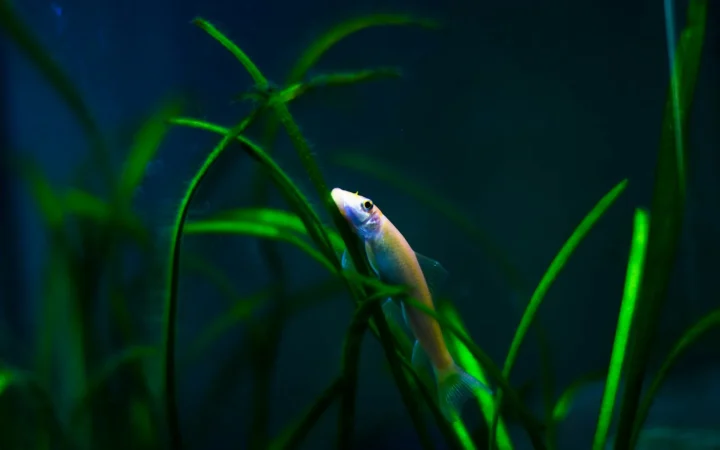
Fish colour is reflected light, so a fish can only show you colours the fixture emits. Put a cardinal tetra under a 14000K marine light and the red stripe turns muddy brown, because there is very little red in the light to reflect.
The same fish under 6500K with decent red output looks the way the shop tank looked. Nothing changed about the animal, only what was falling on it.
Blue and silver fish behave in reverse. Neon dwarf rainbowfish, Congo tetras, and rift lake cichlids gain a great deal from 10000K and above, which is why cichlid keepers reach for cooler fixtures.
Substrate colour shifts perceived Kelvin more than people expect. The same fixture over black sand reads two or three hundred Kelvin cooler to the eye than over natural gravel.
Plants barely notice
Chlorophyll a and b absorb most strongly in the blue near 430 to 450 nm and the red near 640 to 670 nm. Every white LED across the 5000K to 10000K range contains both, in usable quantities.
Growth differences between 6500K and 10000K in a freshwater tank are small enough that most hobbyists cannot detect them without controlled measurement. Intensity and daily hours do far more, which is why the argument belongs with how PAR, colour, and hours fit together rather than with colour alone.
Where spectrum does matter is plant colour rather than plant growth. Red stem plants such as Ludwigia and Alternanthera develop deeper pigment under higher intensity and stronger red output, though light level drives that far more than the Kelvin label does.
The red that goes missing
Colour rendering index measures how faithfully a light shows colours against a reference. A CRI of 100 is perfect, cheap white LEDs often sit around 70 to 80, and better planted fixtures reach 90 or above.
Low CRI is why a tank can look correct in Kelvin terms and still look flat. Most inexpensive white LEDs are blue diodes coated in yellow phosphor, and that construction leaves a dip in the deep reds around 660 nm.
Two fixtures both marked 6500K can therefore look completely different. The one with dedicated red diodes will make your fish look alive and the phosphor only unit will make them look like photographs of themselves. The general principle is set out plainly in the US Department of Energy material on LED lighting at energy.gov.
Mixing channels on an adjustable fixture
Fixtures with separate red, green, blue, and white channels let you build a colour temperature rather than pick one. That flexibility catches people out because the obvious settings are wrong.
Running blue at 100 percent looks impressive for about a week and then makes every fish in the tank look dead. A workable starting point on a four channel unit is white at 80 to 100 percent, red at 60 to 80, green at 40 to 60, and blue at 40 to 60.
From there adjust one channel at a time and live with it for several days. The eye adapts fast, and a change that looks extreme on the first evening usually reads as normal by the third.
Photograph the tank after every channel change with the same phone settings. Your eye adjusts to a colour cast within minutes, so photos taken a week apart are the only honest comparison.
Two tanks, one setting
A shop I service runs two 90 cm tanks side by side, same fixture model, same plants, same stock of harlequin rasboras. One looked like a shaded river. The other looked like a hospital corridor.
The second was running blue at full output and red at 50 percent, which put it somewhere near 10000K by eye. I dropped blue to 60 percent and lifted red to 75, landing it around 7000K.
The harlequins went from pale grey with an orange smudge to properly copper. The Cryptocoryne wendtii at the back, which had been reading almost black, showed the bronze it is supposed to have.
Nothing about the intensity changed and both tanks grew identically afterwards. One simply stopped looking like a display case and started looking like water, and the fix took under a minute on the controller.
Kelvin drifts as the fixture ages
LED diodes lose output over years, and they do not all lose it at the same rate. Blue diodes usually hold up better than the phosphor layer that produces warm output, so an ageing white fixture tends to creep cooler and bluer.
Expect a noticeable shift somewhere past three to five years of daily use on a mid range unit. Reputable fixtures are rated to keep around 70 percent of original output at 50,000 hours, which is roughly seventeen years at eight hours a day, though colour consistency fails long before brightness does.
Sudden colour shift is a different matter entirely and usually means a driver or a diode string has failed. A tank that turns blue or green overnight is described in what a dead LED channel looks like from the front glass, and the slower version is covered in whether aquarium LEDs really lose output with age.
Picking your number
Start at 6500K if the tank is planted and you have no strong preference. It flatters green, keeps reds honest, and gives you room to move in either direction.
Shift warmer toward 5000K for driftwood heavy or blackwater layouts, and cooler toward 10000K for rock, sand, and rift lake fish. Adjust in small steps, and give each setting a week before judging.
If your fixture ramps, remember that the colour changes through the ramp on many units. A sunrise curve that starts warm and finishes neutral looks excellent, and the practical settings for that are in how ramping and dimming are best set up.
There is no correct Kelvin figure, only a correct one for your fish, your hardscape, and your eyes. Anyone who tells you otherwise is quoting a marine chart at a freshwater tank.
Questions readers ask about this
For planted freshwater, 6500K is the better default. It renders green foliage naturally and keeps warm fish colours intact. Choose 10000K if you keep rift lake cichlids over pale rock and sand, where the cooler cast suits blue and silver fish and makes the hardscape look crisp rather than yellow.
Barely, within the normal aquarium range. Every white LED between 5000K and 10000K carries usable blue near 440 nanometres and red near 660 nanometres. Intensity at the substrate and daily hours drive growth rate far harder. Above 14000K the balance shifts enough that freshwater plants do lose out.
Usually low colour rendering rather than the wrong Kelvin figure. Cheap white LEDs are blue diodes under yellow phosphor, which leaves a dip in deep red output around 660 nanometres. Reds and oranges have nothing to reflect. A fixture with dedicated red diodes fixes it immediately.
You can, and it works better than people assume. Pairing a warmer 6500K unit with a cooler 10000K unit gives a blended cast somewhere between them and improves colour rendering by filling spectral gaps. Mount them at equal height or you will get visible colour banding across the tank.
Around 5000K, sometimes lower. Warm output suits tannin stained water, driftwood, and leaf litter, and it makes the amber tint read as intentional rather than dirty. Plant selection has to follow, since shade tolerant species like Java fern and Anubias handle that setting comfortably.