Key takeaways
- Only gaseous CO2 crosses the air gap, which is why the reading reflects carbon dioxide alone and not tank buffers or organic acids.
- The scale is only valid with 4 dKH reference solution; filling the checker with tank water can hide 60 ppm behind a reassuring green.
- Grass green at 4 dKH is roughly 30 ppm, while yellow green at pH 6.4 is already near 48 ppm.
- Expect a one to two hour lag, so read the checker in the last hours before lights out rather than treating it as live data.
- Replace the indicator solution every two to four weeks, because a faded checker sits on one shade no matter what you adjust.
A customer once sent me a photo of a drop checker sitting at a perfect grass green, with two dead amano shrimp in the same frame. The equipment was not lying. He had topped the checker up with tank water instead of reference solution, and a green reading in KH 8 water means something entirely different from a green reading in KH 4.
That single mistake accounts for a good share of the gassing incidents I see in tanks that look, on paper, perfectly dialled in. The glass bulb is a good instrument. It is also easy to render useless without noticing.
What is actually happening inside the glass
A drop checker is a small sealed chamber with an air gap between the tank water and a few millilitres of indicator fluid. Water cannot cross that gap, and neither can nitrate, tannins, or anything else dissolved in your tank. Gaseous CO2 can.
CO2 leaves the tank water, crosses the air gap, and dissolves into the fluid, where it forms carbonic acid and lowers pH. The indicator, bromothymol blue, changes colour with that pH. So you are reading tank CO2 indirectly, through a fluid whose chemistry you control completely.
That control is the whole point. Your tank water contains buffers, organic acids, and the products of nitrification, so its pH responds to several things at once. The reference solution responds to exactly one.
Why the solution has to be 4 dKH
The relationship between carbonate hardness, pH, and dissolved CO2 is fixed and calculable. A workable approximation is CO2 in ppm equals 3 multiplied by dKH multiplied by 10 to the power of (7 minus pH).
Fix the hardness at 4 dKH and the arithmetic collapses to a single number for each pH. At pH 6.6 you get 30 ppm, the number most planted tank keepers aim at. Change the hardness and every colour on the scale now means a different concentration.
Reference solution costs around $8 to $12 for a bottle that will last a year or more. You can mix your own with roughly 0.12 grams of pure sodium bicarbonate per litre of distilled water, but kitchen scales that read to 0.1 g are not accurate enough to be worth trusting on something that guards your livestock. Buy the bottle.
Never fill a drop checker with tank water, and never top one up with it. If your tank sits at KH 8, a green reading corresponds to roughly 60 ppm CO2, twice the intended target, and the checker will look reassuring right up until fish start gasping.
Blue, green, yellow, and the numbers behind them
Bromothymol blue runs yellow at low pH and blue at high pH, with green in the middle. Those figures below assume a proper 4 dKH solution at normal room temperature.
| Colour | pH in the checker | Dissolved CO2 | What it means |
|---|---|---|---|
| Deep blue | 7.0 and above | Under 12 ppm | Injection is doing very little |
| Blue green | Around 6.8 | About 19 ppm | Room to raise, in small steps |
| Grass green | Around 6.6 | About 30 ppm | The usual target, hold here |
| Yellow green | Around 6.4 | About 48 ppm | Too high, reduce and watch fish |
| Yellow | 6.2 or below | 75 ppm and up | Cut gas now and aerate |
Note how compressed the danger zone is. The difference between 30 ppm and 48 ppm is one fifth of a pH unit inside the glass, which on a bad day is the difference between a lush tank and a dead one.
Green is not one colour either. A yellowish green and a bluish green are perhaps 15 ppm apart, so hold a sheet of white paper behind the glass and look in daylight rather than under planted tank lighting.
The lag that catches people out
Gas has to cross an air gap and equilibrate with two or three millilitres of fluid. That takes time, typically one to two hours, occasionally closer to three on a cool tank with gentle flow near the checker.
So the colour you see is a report on the recent past, not the present moment. Check it at lights on and the reading still carries some of last night’s overnight low.
The practical fix is to read it at the same point every day, ideally in the final hour or two before lights out, when dissolved CO2 has peaked. That is also the moment the tank is under most stress, which is why the timing of injection against your photoperiod matters as much as the rate, something covered in how the gas schedule should sit against the lighting schedule.
A drop checker will not warn you fast enough during an actual dump. If a regulator surges at 2am, the checker turns yellow well after the fish are already in trouble. It is a tuning instrument, not an alarm.
Where to hang it
Put the checker at the opposite end of the tank from the diffuser, in the lower half of the water column. Near the diffuser you read a local plume rather than the water your fish are living in.
Keep it out of the direct bubble stream, and keep it clear of the surface where degassing is fastest. If a bubble lodges in the neck of the glass it will block gas exchange entirely and the reading freezes.
One checker is enough on a tank up to about 200 litres. On anything longer than 120 cm, two checkers at opposite ends will often disagree, and that disagreement points at flow distribution rather than injection rate, which is a plumbing question dealt with in the full run from cylinder through to diffuser.
Maintenance, which almost everyone skips
Change the solution every two to four weeks. Bromothymol blue degrades with light exposure and the indicator gradually loses sensitivity, drifting toward a permanent stale green that no longer moves.
Rinse the glass with distilled water at every change, and clear any algae film off the inside with a cotton bud. A film on the inner wall skews the colour you perceive even when the chemistry is fine.
If a checker has sat at exactly the same shade for a month while you have been adjusting the needle valve, the solution is dead. Replace it before you conclude anything about your injection.
What the checker cannot tell you
It gives you concentration, not stability. A tank that swings from 12 ppm at lights on to 45 ppm at lights off can average out to something that looks fine at whatever moment you happen to glance at the glass.
For that you want a direct measurement, comparing degassed pH against pH under injection, which is the more precise approach described in measuring the actual drop against a degassed baseline. Most people use both: pH figures for setting the rate, the checker as a daily glance.
It also says nothing about oxygen, and oxygen is what actually kills. Fish at the surface with a green checker still means cut the gas, because the fish are better instruments than the glass, and the behaviour that precedes losses is worth learning by sight. The chemistry underneath all this is standard water science, summarised well by the USGS explanation of pH in water.
Back to the shrimp tank
The 60 litre shrimp tank in that photo was running a ceramic diffuser at about 1.5 bubbles per second into KH 8 tap water. Filling the checker from the tank meant the fluid was four times too hard to read against the standard scale.
We emptied it, rinsed it with distilled water, refilled with proper 4 dKH solution, and left it two hours. It came back a firm yellow, which put the tank somewhere north of 60 ppm.
Cutting the rate to 0.8 bps and rebuilding it slowly over ten days brought it to a stable green at 1.1 bps, and the remaining shrimp were fine. If you are setting a rate from scratch, do it the slow way described in the staged approach to raising bubble count rather than trusting a single colour reading on day one.
Questions readers ask about this
Either very little gas is reaching the water or the checker is misplaced. Check for leaks at the fittings first, then confirm the diffuser is actually producing mist. If both are fine, move the checker out of a dead corner and into moving water. Blue at 4 dKH means under 12 ppm, so the rate genuinely needs raising in small steps.
You can, and it will usually sit blue, showing 3 to 8 ppm from fish respiration and the atmosphere. That is normal and not a fault. Its main value in a low tech tank is confirming that surface agitation has not driven CO2 to nothing, which occasionally limits growth in tanks with an aggressive skimmer or a very turbulent return.
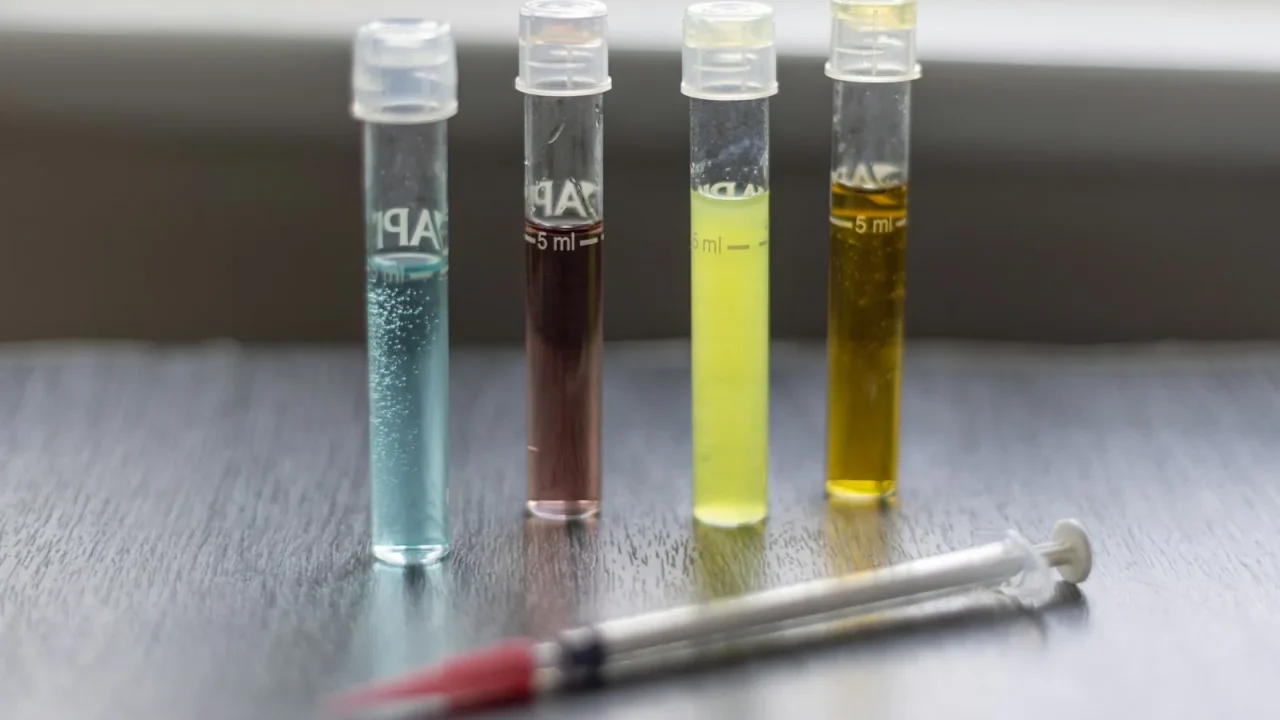
Roughly two to three millilitres, or enough to fill the lower bowl about half way. Overfilling is the common error, because fluid that reaches the neck blocks the air gap and stops gas exchange entirely. Add three or four drops of bromothymol blue if you are using unindicated solution, then let it sit two hours before reading anything.
Slightly. The pH to CO2 relationship shifts a little with temperature, so a tank at 28C (82F) will read marginally differently from one at 22C (72F). The effect is small next to the error introduced by wrong hardness or a stale indicator. Do not adjust your target for it; correct hardness and fresh solution matter far more.